
AV Blocks for NCLEX: 1st, 2nd & 3rd Degree Heart Block Complete Guide
Recognize all 4 types on EKG strips — inline rhythm strips, atropine vs. pacing rules, nursing interventions, and NCLEX practice questions
AV blocks show up on NCLEX because they test two things at once: rhythm recognition and clinical judgment. The block you identify changes everything about the nursing response — whether atropine is appropriate, whether pacing pads need to go on, and when to call the provider versus when to act first.
We cover all four types with inline EKG rhythm strips, the key NCLEX distinctions, and nursing management for each. Sources are at the bottom.
2. When atropine works and when it doesn't — a direct, frequently tested question type
3. Priority action for hemodynamically unstable high-degree block — TCP, not atropine
4. Recognize the PR pattern: prolonged & constant → lengthens then drops → constant then suddenly drops → no PR relationship at all
5. Scope of practice: when to notify, when to act, and when to hold a medication
AV Block Overview & Comparison
All AV blocks involve some degree of impaired conduction between the atria and ventricles. What separates them is where the block is and how the PR interval behaves — those two things tell you the risk level and what to do about it.
| Block Type | PR Interval | Dropped QRS? | QRS Width | Block Site | Danger Level | Atropine? | Pacing? |
|---|---|---|---|---|---|---|---|
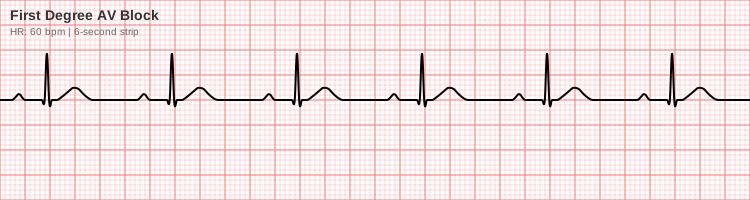
| 1st Degree | Prolonged >0.20s — constant | No | Narrow | AV node | Benign | Rarely needed | No |
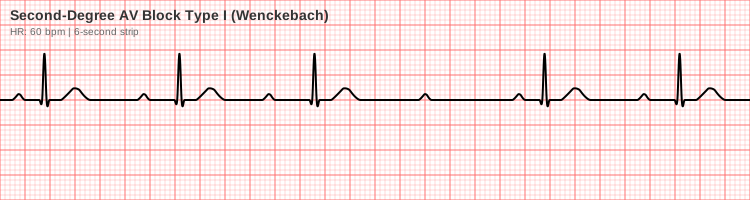
| 2nd Degree Mobitz I (Wenckebach) | Progressively lengthens until dropped QRS, then resets | Yes — cyclically | Narrow when conducted | AV node | Low–Moderate | Yes, if symptomatic | Rarely needed |
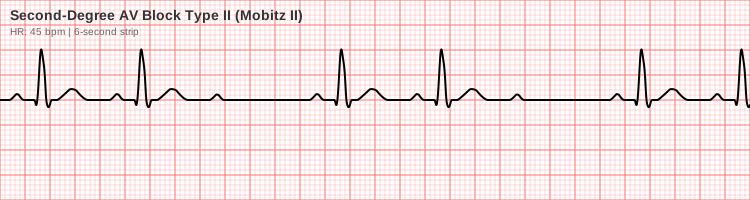
| 2nd Degree Mobitz II | Constant in conducted beats — sudden drop with NO warning | Yes — sudden, unpredictable | Often wide | Infranodal (below His bundle) | High — can progress to 3rd degree suddenly | Not effective | Yes — pacing priority |
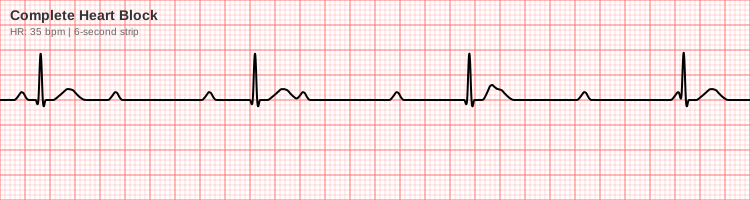
| 3rd Degree (Complete) | No consistent PR — full AV dissociation | Yes — all P waves blocked | Wide (ventricular escape) or narrow (junctional escape) | AV node or infranodal | Critical — emergency | Ineffective for wide QRS escape | Yes — emergent, immediately |
1st Degree AV Block — The Delay
First-degree AV block is a delay — not a block in the true sense. Every P wave still reaches the ventricles; the impulse just takes longer than normal to pass through the AV node. On the strip: regular rhythm, PR consistently longer than 0.20 s, no dropped beats, cardiac output intact.
Nursing Management
- Review the MAR for AV nodal–slowing agents (digoxin, beta-blockers, diltiazem, verapamil, amiodarone)
- If medication-induced: hold contributing drug per provider order or MAR parameters — do not hold independently without an order or documented parameter
- In acute inferior MI: monitor for PR interval lengthening on each rhythm documentation — notify provider of progression toward higher-degree block
- Document PR interval in nursing notes with each rhythm strip
2nd Degree Mobitz I (Wenckebach) — The Progressive Block
Wenckebach has a recognizable pattern once you know what to look for: beats grouped together, then a pause, then it repeats. What's happening underneath is that the AV node conducts each successive beat more slowly until one impulse fails to get through at all — a QRS is dropped. Then the AV node recovers and the cycle starts over. The P-P interval stays regular throughout; it's only the PR that keeps lengthening until it can't.
Nursing Management
- Asymptomatic: No treatment required — identify and address reversible causes; monitor for progression in acute settings
- Symptomatic (hypotension, presyncope): Notify provider immediately; anticipate and administer atropine per provider order or standing protocol (Wenckebach is nodal — atropine may improve AV nodal conduction)
- In acute inferior MI: obtain 12-lead ECG, notify provider, and monitor closely for progression to higher-degree block
- If medication-induced (digoxin, beta-blockers, CCBs): hold per provider order/MAR parameters
2nd Degree Mobitz II — The Dangerous Block
Mobitz II is the one that keeps nurses on edge — and for good reason. The PR is constant right up to the moment a QRS is unexpectedly dropped. There's no progressive warning, no pattern you can anticipate. The block is infranodal, below the His bundle, and the backup pacemaker is ventricular — slow, wide, and unreliable. It can progress to complete heart block at any moment without any change in the strip beforehand.
⚠️ Why Mobitz II Is Dangerous
The ventricular escape pacemaker (20–40 bpm, wide QRS) that takes over if the block completely fails is slow and unreliable. There is no gradual warning — the rhythm can jump from 2:1 Mobitz II to asystole. Mobitz II is a recognized indication for permanent pacemaker evaluation per cardiology/EP. In the acute setting, continuous monitoring and TCP pads on the patient are mandatory.Nursing Management
- Continuous cardiac monitoring is mandatory — Mobitz II carries unpredictable risk of sudden complete heart block
- Apply transcutaneous pacing pads and ensure defibrillator is powered and at bedside immediately upon recognition
- Notify provider immediately — Mobitz II requires urgent clinical evaluation and likely pacemaker placement
- Obtain 12-lead ECG; assess QRS width in conducted beats; evaluate for acute anterior MI (LAD territory)
- Assess hemodynamic status continuously: BP, mental status, skin perfusion
- If hemodynamically unstable while awaiting pacemaker: Initiate TCP per provider order or emergency protocol; anticipate orders for vasopressor support (e.g., dopamine, epinephrine) — prepare infusions and administer per provider order
- Atropine is not effective for infranodal blocks — anticipate pacing orders rather than atropine
3rd Degree (Complete Heart Block) — Full Dissociation
In third-degree AV block, no atrial impulse reaches the ventricles — not one. The atria and ventricles are firing completely independently of each other: the SA node drives the atria at its normal rate, while a slower escape pacemaker somewhere below the block site drives the ventricles on its own. On the strip, you're watching two separate regular rhythms with no connection to each other.
⚠️ Wide vs. Narrow QRS Escape — Why It Matters
Wide QRS escape (ventricular): 20–40 bpm. Slow, unreliable, dangerously low cardiac output. This is a medical emergency — notify the provider immediately and anticipate TCP per emergency protocol.Narrow QRS escape (junctional): 40–60 bpm. More hemodynamically stable, but still not adequate to sustain the patient long-term. Seen with AV node–level block (inferior MI, digoxin toxicity). Atropine may be ordered by the provider as a temporizing measure — TCP should be prepared regardless.
Nursing Management — Emergency
- Hemodynamically unstable (hypotension, AMS, chest pain): Apply TCP pads and initiate transcutaneous pacing immediately — set rate per provider order (typically 60–80 bpm); increase mA until electrical capture (QRS after each spike) then confirm mechanical capture (palpable pulse with each captured beat)
- TCP is painful — anticipate analgesia and sedation orders as soon as the patient is stabilized; administer per provider order
- Notify provider and cardiology/electrophysiology immediately — do not wait for a second strip confirmation if patient is symptomatic
- Atropine: May be ordered by the provider for narrow QRS junctional escape — administer per order while preparing TCP; do not delay TCP for atropine; ineffective for wide QRS escape (infranodal)
- Anticipate orders for vasopressor support (dopamine or epinephrine) as a bridge while awaiting pacing — prepare infusions and administer per provider order
- Draw stat electrolytes (rule out hyperkalemia); review MAR for digoxin; obtain 12-lead ECG
- Anticipate cardiology/EP consult for transvenous pacemaker placement; irreversible block typically requires permanent pacemaker — document patient's response to TCP and communicate to the team throughout
- Digoxin toxicity: withhold digoxin, notify provider, obtain digoxin level; Digibind (digoxin-specific Fab) per provider order for severe toxicity
Atropine vs. Pacing: What NCLEX Tests
Atropine works by blocking vagal tone at the SA node and AV node — so it can only help rhythms where the problem is the AV node. It has no effect on conduction tissue below the node that has been structurally damaged. That's the reason the same drug that works for sinus bradycardia and Wenckebach has no place in the management of Mobitz II or complete heart block with wide escape.
✅ Nodal Blocks — Atropine May Be Ordered
- Sinus bradycardia
- 1st degree AV block (vagal cause)
- Wenckebach (Mobitz I) — nodal level
- 3rd degree with narrow QRS escape (junctional — AV node block)
🚫 Infranodal Blocks — Atropine Not Effective
- Mobitz II (infranodal block)
- 3rd degree with wide QRS escape (ventricular — below His)
- Any block from structural damage to bundle branches
- Anterior MI with new bundle branch block
Quick Framework: The PR Gives It Away
On NCLEX, you can identify every AV block by answering three questions about the PR interval — in order.
The shortcut: If the QRS is wide and the PR is either absent or constant before a sudden drop — the block is infranodal. Atropine works on the AV node, not below it. Anticipate pacing orders.
🎓 NCLEX-Style Practice Questions
Five NGN-style scenarios — click an answer to see the rationale.
Question 1
A nurse is reviewing the cardiac monitor for a post-op day 2 patient who received diltiazem 30 mg PO twice daily as a new order. The telemetry strip shows a regular rhythm at 68 bpm with a PR interval of 0.24 seconds. All P waves are followed by a QRS. The nurse's priority action is to:
A PR interval of 0.24 s (>0.20 s) with a regular rhythm, all P waves conducting, and no dropped beats = 1st degree AV block. Diltiazem is a non-dihydropyridine calcium channel blocker that slows AV nodal conduction and is a known cause of prolonged PR interval.
First-degree AV block does not require transcutaneous pacing (A). The nurse cannot independently hold a medication without a provider order or documented MAR parameter (B). Atropine is not indicated for asymptomatic 1st degree block (D). The correct action is to assess the patient, document the finding, and notify the provider — who will determine whether to adjust the dose or add a PR monitoring parameter. This is classic NCLEX scope-of-practice combined with rhythm recognition.
Question 2
The nurse caring for a patient admitted with an acute inferior STEMI notes the following on the cardiac monitor: the PR interval is 0.18 s on the first beat, 0.24 s on the second, 0.32 s on the third, and then no QRS complex follows the fourth P wave — after which the PR resets to 0.18 s. The patient's BP is 108/72 mmHg and the patient is alert. Which action is most appropriate?
The progressively lengthening PR (0.18 → 0.24 → 0.32 → dropped QRS → resets) is classic 2nd degree AV block Mobitz I (Wenckebach). It is an expected complication of inferior STEMI because the RCA supplies the AV node, and AV nodal ischemia causes reversible Wenckebach.
This patient is hemodynamically stable (BP 108/72, alert) — immediate TCP is not indicated for asymptomatic Wenckebach (A). Nurses do not independently administer atropine without a provider order in a non-arrest situation (B). D is wrong because Wenckebach must be documented and reported — the provider needs to know about it and should assess for progression. The rhythm may be benign, but notification is always required when a new significant rhythm change occurs.
Question 3
A nurse caring for a patient in the cardiac ICU after a large anterior MI reviews the telemetry strip. The rhythm shows a regular P-wave rate of 80 bpm. The PR interval in conducted beats is 0.18 s and does not change. Every third P wave is not followed by a QRS. The QRS complexes are wide (0.14 s). The patient's BP is 82/50 mmHg and the patient is diaphoretic and confused. Which intervention is the priority?
Constant PR + sudden dropped QRS + wide QRS + hemodynamic compromise = 2nd degree Mobitz II, hemodynamically unstable. This is an infranodal block (LAD territory anterior MI damaged the bundle branches). The patient has signs of cardiogenic shock (BP 82/50, diaphoresis, confusion).
Atropine is NOT effective for infranodal Mobitz II (A) — it accelerates the atrial rate but cannot improve conduction below the damaged His-Purkinje system, and may worsen the ventricular rate. Waiting for ECG before acting when the patient is hemodynamically compromised (C) wastes critical time. IV fluids (D) will not address a conduction problem. The ACLS priority for hemodynamically unstable Mobitz II is transcutaneous pacing immediately, with simultaneous provider notification.
Question 4
A nurse is evaluating a rhythm strip and notes: P waves at a regular rate of 72 bpm; wide QRS complexes at a regular but independent rate of 35 bpm; the distance from P to the next QRS changes with every beat. The patient is lethargic and has a BP of 74/48 mmHg. Which description most accurately identifies this rhythm?
The defining triad for complete heart block: (1) Both P and QRS rhythms are regular — different rates. (2) No consistent PR relationship — the PR changes with every beat because no P conducts. (3) AV dissociation — atria and ventricles beating independently.
Mobitz II (A) has some P waves conducting with a constant PR — not this pattern. Wenckebach (B) has the PR lengthening in a cycle. Junctional rhythm (C) would have no visible P waves. This patient's wide QRS escape rate of 35 bpm indicates infranodal complete heart block — a critical emergency. Expect TCP to be initiated immediately per provider order, with vasopressor/chronotropic support and pacemaker placement to follow.
Question 5
A nurse has applied transcutaneous pacing pads to a conscious patient with 3rd degree AV block. TCP has been initiated at a rate of 70 bpm at 60 mA. The monitor shows a spike followed by a QRS on every beat. The patient says, "I feel like someone is punching me in the chest — I can't take this." The most appropriate response by the nurse is to:
TCP is painful — electrical current stimulates chest wall muscles and skin, causing intense contractions. Analgesia and sedation are standard of care once the patient is being paced. This is a well-tested NCLEX nursing comfort/advocacy question about TCP.
Decreasing mA (A) risks losing electrical capture — the correct capture threshold must be maintained. Turning off TCP (B) removes life-sustaining pacing in a patient with complete heart block — this is dangerous. Independent pad repositioning (D) is a scoped procedural change that requires a provider order. The nurse should acknowledge the pain (therapeutic communication), briefly explain it is expected and temporary, and immediately contact the provider for analgesia and sedation orders per facility protocol.
🖥️ Practice AV Block Recognition on Our EKG Simulator
See AV block rhythms rendered in real time across 36 cardiac rhythms. Toggle between strips, test your interpretation, and drill the pattern differences that show up on NCLEX.
Launch EKG Simulator →📚 Sources
- Sandau, K. E., Funk, M., Auerbach, A., Barsness, G. W., Blum, K., Cvach, M., . . . & On behalf of the American Heart Association. (2017). Update to Practice Standards for Electrocardiographic Monitoring in Hospital Settings: A Scientific Statement From the American Heart Association. Circulation, 136(19), e273–e344. https://www.ahajournals.org/doi/10.1161/CIR.0000000000000527 [ECG monitoring indications, AV block monitoring recommendations, and AV block classification directly cited; content verified on this page]
- Panchal, A. R., Bartos, J. A., Cabañas, J. G., Donnino, M. W., Drennan, I. R., Hirsch, K. G., . . . & Berg, K. M. (2020). Part 3: Adult Basic and Advanced Life Support: 2020 American Heart Association Guidelines for Cardiopulmonary Resuscitation and Emergency Cardiovascular Care. Circulation, 142(Suppl 2), S366–S468. DOI: 10.1161/CIR.0000000000000916. [ACLS bradycardia algorithm, transcutaneous pacing indications, atropine ineffectiveness for infranodal AV blocks — clinical management throughout this article]
- National Council of State Boards of Nursing (NCSBN). (2026). 2026 NCLEX-RN Examination Test Plan. NCSBN. https://www.nclex.com/test-plans.page [NCLEX content framework; conduction disorders and cardiac monitoring appear under Physiological Adaptation — Alterations in Body Systems; effective April 1, 2026]
- Garcia, T. B. (2015). Introduction to 12-lead ECG: The art of interpretation (2nd ed.). Jones & Bartlett Learning. [AV block classification, PR interval diagnostic criteria, and rhythm recognition; Figures 8-27 through 8-30 directly cover all four AV blocks discussed in this article]